
|
|
|
| Regardless from whom you purchase your Festool tools, most if not all your Festool purchases will be delivered direct to your door from one of two Festool warehouses. Consequently, I thought you might be interested in how the tools are packaged for shipment.
I received four packages. One package contained the dust extractor. The dust extractor was double-boxed and bubble-wrapped for maximum protection. It arrived without a scratch. Its hose was shipped inside the extractor. The two aluminum guide rails were also packaged well. The longer of the two rails was packaged in a wood-framed, hardboard covered container. The smaller guide rail was shipped in a box and protected on the inside by 1/4" luan panels. Consequently, these tools arrived in perfect condition. The circular saw and the guide rail accessories were boxed and bubble-wrapped but not double-boxed. Double-boxing was not necessary since the saw and the saw accessories were shipped in their own Festool "systainers". Let's take a closer look at the Festool systainer system...... | 
|
|
The Festool systainer (system container) is a unique way of packaging a tool. A number of my portable tools came with fitted cases that typically do nothing more than catch dust on our tool shelves. The systainer cases are a bit different.
Each systainer is a hard plastic box, which I am told meets European mail standards for shipping. Systainers are designed to snap onto other systainers using a sliding latch arrangement. Consequently, you can keep all of your Festool tools (circular saw, sanders, router, jig saw) in their respective systainers, stacked one on top of the other. Festool sells a modestly priced systainer base and a standalone tool cabinet for those who prefer those options. Festool also sells empty systainers and foam inserts in various sizes to provide a home for your non-Festool tools, accessories, and parts. | 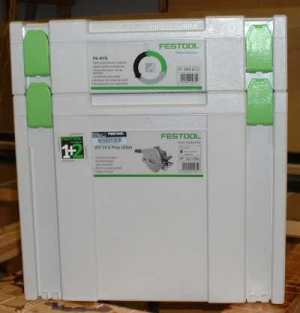
|
| The Festool CT 22E dust extractor is designed to serve as a systainer base, a feature we like in our shop. Since the dust extractor is on wheels, we can wheel it, the saw, and the guide rail accessories to any location in or outside the shop. This is a great feature for cabinet makers and finish carpenters working at job sites. They can simply wheel their tools, accessories, and parts into the work location and setup shop in a matter of minutes.
The systainers are a rugged, attractive, and unique way of organizing ones tools. Though a feature I had overlooked prior to using the Festool tools, I am sure the systainer container system is a selling point for woodworkers who like to keep their shops organized and tidy and for cabinetmakers/carpenters who work at a remote job site. The only negative I found with the systainer system is that when you have multiple systainers locked together, you can only open the top-most systainer. | 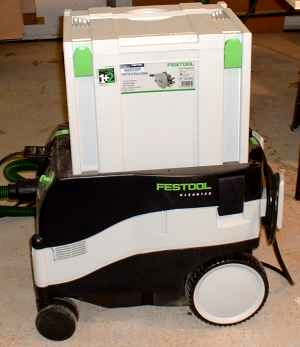
|
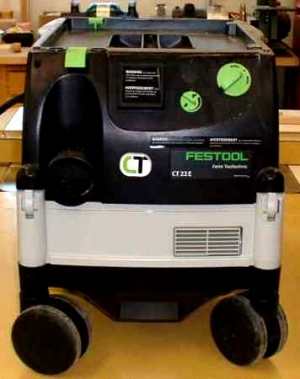 Until recently, I did not get too excited about dust extractors and dust collection in general. However, anyone with an open mind realizes the dangers of breathing fine dust particles. At best, dust is a nuisance in the shop and job site that must be discarded. If you're working in someone's home, it is especially important to collect your dust and debris. I know all of this, but over the years I have not been a great practioneer in dust collection.
A few years ago we invested in two Fein dust extractors. They work great. They provide an accessory outlet for a power tool so that the extractor automatically runs when the power tool is started. They're relatively quiet, easy to wheel around, the hose locks into the inlet, and generally do what a dust extractor should do, suck dust! On the negative side, they are prone to tip over (though better balanced than most shop-vacs) and provide no onboard storage for the cord or hose-- consequently, depending on who last used it, the cord and hose are generally under foot.
The Festool CT22E provides all of the features of our Fein units including:
However, the Festool CT22E provides the following additional features:
The only negative I have experienced with the Festool CT22E in comparison with the Fein (and other shop vacs), is it appears that you must use a filter bag to protect (extend the life of) the filters. Our Fein units each have a large conical cloth filter that allows the big stuff to collect in the tank. All material collected by the Festool ends up in the bag. Festool offers a large reusable bag, but it is quite expensive. (See remarks from Festool USA CEO Christian Oltzscher below.)
When used with the ATF 55E circular saw and our covered cutting table, the CT22E extracts virtually all of the dust. Some dust escapes towards the front at the end of the cut (as the blade exits the workpiece), but that's it. Consequently, a lot less dust ends up in our lungs, saving our health. And a lot less dust ends up on the floor, saving us time. The ATF 55E/CT22E combination would be the ticket when working in a customer's home (or your home), especially a carpeted room, as it leaves very little dust/debris to clean up.
In response to my CT22E remarks, Christian Oltzscher of FESTOOL USA writes...
You can use the CT22E without a filter bag. However, we recommend that you use the long life main filters (Longlife-HF-CT /2, $39.50 USD) if you plan to use the CT22E without a filter bag. If you don't vacuum water and wet material, the Longlife-HF-CT /2 filter will last you a very long time.
But why use a dust extractor at all if you plan to dump the dust and debris in a trash can, spreading the dust over yourself and your workspace? If you use a bag, you can seal it, remove it from the CT22E, and place it in the trash safely and cleanly. We make this the customer's choice, but if you want to avoid dust completely, go with the four dollar filter bags (FIS-CT 22 /5, $20.00 USD for a pack of 5), fill them, seal them and dump them.
In regards to the longlife filter bag (Longlife-FIS-CT 22, $140.00 USD), it is worth the money if you use the CT22E to extract dust and debris from a planer or other device that produces large chips/debris. Dumping planer chips out of the bag is not a problem and since the contents is primarily chips, you are not exposing yourself and workshop to dust. The longlife filter bag is the price of 35 standard paper bags. Since you can fill up a filter bag quickly when extracting debris from a planer or similar device, the longlife filter bag pays for itself after a few weeks and it lasts a very long time.
Dust extraction is a very interesting topic. You wrote that [in the past] you did not take much care or thought regarding dust extraction. I hear and read similar comments every day--many craftsmen do not care much about dust extraction. Please allow me to share my thoughts regarding dust extraction...
- Using an efficient dust extractor with a sander significantly extends the life of sandpaper. If you use our Rotex dual mode sander in the aggressive mode with coarse grit sandpaper without dust extraction, the sandpaper will clog up very quickly [similar to a drum sander without dust extraction]. If you use the same sander and sandpaper with our dust extractor, the sandpaper stays clean resulting in much longer sandpaper life. Consequently, you will realize a real cost savings in material (sandpaper) and the time it takes to change it.
- Using a dust extractor saves time cleaning up after a job is finished. If you use dust extraction with our sanders, routers, and circular saws, there is (almost) nothing to clean up afterwards. If you're at a customer's site or home, you do the job, straighten up, and leave! Since the debris and dust is captured in the dust extractor, your cleanup time is cut drastically.
- You can improve sanding results by using a dust extractor. When finish sanding with fine grit sandpaper, with some materials, the dust emitted from sanding is actually coarser than the sandpaper itself. Consequently, the dust may scratch the very surface you're trying to smooth! Meanwhile, you continue to sand wondering why you can't get a good finish....
- Finally, using a dust extractor will extend the lifetime of the tool itself.
By the way, Festool realizes that there is a significant health issue regarding dust. However, we don't use it as a selling point. I believe that scaring craftsmen with lung cancer to push them to buy a dust extractor is the wrong thing to do. There are many good and perhaps obvious reasons to use an efficient dust extractor system. And I'm not just saying this because I want to sell dust extractors. Festool and I would rather see a craftsman using a competitor's dust extractor than no dust extractor at all.
Just some thoughts on a Saturday afternoon.
Thanks and best regards,
Christian
Wow, thanks Christian for your comments. In is nice to know that a CEO can articulate the value of his products and is concerned enough about the woodworking community to provide this kind of feedback! Thanks again!
From a performance point of view, it's the Festool guide rails that really set this saw apart from our DeWALT and Porter Cable saws. It may be a bit unfair to compare DeWALT and PC saws with the ATF 55E, since they were designed first and foremost as framer's tools, and as such do a fine job. However, many of us use these saws to cut panels and do finish carpentry and this is where the ATF 55E and its guide rails really shine.
I have made and use a number of guides with our circular saws. They work fine. However, since they are not "integrated" with the saws, I do have to be careful in operation to keep the saw up against the fence of the guide. Also, since the guides are made of wood, they are heavy and are prone to getting banged up.
Here is a list of what I like about the Festool guide rails:
In several weeks of use I have not found a single thing I don't like about the guide rails, nor anything I would change. However, in regards to the guide rail accessories, it would be great if there were some method of indexing or locking the angle guide to 0° and perhaps 45°, or perhaps a fixed guide. I found the engraved angle lines are accurate, but in use, if I did not set the angle guide (once attached to the guide rail) to a reference board or square, the finished cut was not exactly at the desired angle. This does not indicate that the engraved lines are inaccurate, but due to the length of the guide and the small radius of the angle guide, an imperceptible error in aligning the angle lines results in a perceptible error near the end of the guide.
It is a real pleasure to use the ATF 55E, the guide rails, and the CT22E. The circular saws I use in the shop are not designed specifically for cabinetmaking and finish carpentry. With the proper blade, shop-made or purchased guide rails, and careful setup, saws like the DeWALT 364 and PC 743 work very well. However, out of the box, the ATF 55E and its supplied 55" guide rail (and available 106" guide rail) work perfectly in our shop. The dust collection capability of the ATF 55E, when mated to the Festool CT22E (or our Fein Turbo II), is excellent. As previously noted, it is virtually impossible to attach a dust collection hose to our DeWALT 364.
I like the integration of the ATF 55E, the guide rails, guide rail accessories, the systainers, the dust extractor, and so forth. It is obvious that the Festool designers looked carefully at the needs of the small shop / job site carpenter/cabinetmaker, and produced a system that would be easy to use, reliable, accurate, and so forth. In fact, it's performance is really RARE (Repeatable, Accurate, Reliable, Ergonomic) (okay, I'm getting sappy). The quality and accuracy of cut I get with the ATF 55E and its guide rails, in conjunction with our panel cutting table, does away with any further though we've had about purchasing a panel saw.
Thanks again to Festool for the opportunity to use these tools in our shop. Hopefully, in a week or so we can post pics and possibly more videos of the kitchen remodel (24 feet of cabinets) we're performing, using the Festool tools.
I have decided to add comments from owners, readers, and .... regarding the tools I review.
Doug Peck writes...
I love them and have used them for years! Really quality products that are worth every penny. I've never had a problem in prob. three years or more.
Ron Remmel writes...
I recently picked up the same Festool setup described in your post. Wow. I am getting a cleaner cut with my saw and guide than I do with my unisaw on sheet goods. I was planning on either buying the multifunction table made by Festool or building my own when I saw you panel saw post with the picture of your table. If you would be kind enough to share your URL with me I would very much appreciate reading up on the table you built. By the way, have you bought the router or other Festool products. I am in the process of putting together an order for the router and some accessories as it seems to be a perfect match for the rails and extractor. Thanks for your help. Regards, Ron
John McCafferty writes...
Thanks for that Jack - I am a bit of a Festo enthusiast and you review their tools very well! I would like to pass on a couple of things..... First up - the Systainer System. These boxes are a heaven in themselves when working "on-site". They store the tools & accessories very well but because they are modular in size and very strong but light weight they are fantastic for "standing-on" - making tressles for sawing / routing etc - a couple "stacked-up" make a great "chair" during coffee breaks - the list is endless. The complete range of Festools is not yet available in the US (marketing reasons perhaps). There is a massive system called the "Basis" - a fold-up table with insert plates that accepts circular saws with depths of cut from 2" to about 3 1/2" - 2 different sizes of Routers, jigsaw, a belt sander, with quite ingenious attachments, table extensions, a sliding table (which is a simplified sliding table for smaller work like routing end grain on boards up to 16" wide), modular racks for storing the whole lot, and so forth. I am about 3/4 the way through of combining this "Basis" system so if you want any pics or more detailed info e-mail me and I will try to help. John
In response to John's remarks, Christian Oltzscher of FESTOOL USA writes...
The "Basis" system is not available in the U.S. due to product liability reasons, not for marketing reasons. We do not have UL approval for the system. As you know, most of the "Basis" components such as the ATF 55, OF 1000, and the PS 2E have UL approval. As John eludes to, it is a very nice system but it was originally designed and is currently produced according to European safety standards and not according to UL safety standards.
If you have any questions, E-Mail Us!
